A personal and scholarly quest
My first encounter with Raphael happened as a child, leaving a deep and lasting impression that shaped a lifelong quest to understand the man and his work.
The person behind the quest
I have spent my career at the intersection of data, information technology, and business. With the emergence of AI, my focus shifted toward something more specific: knowledge-rich domains where extraordinary expertise exists but has never been made accessible to the people who would benefit most from it.
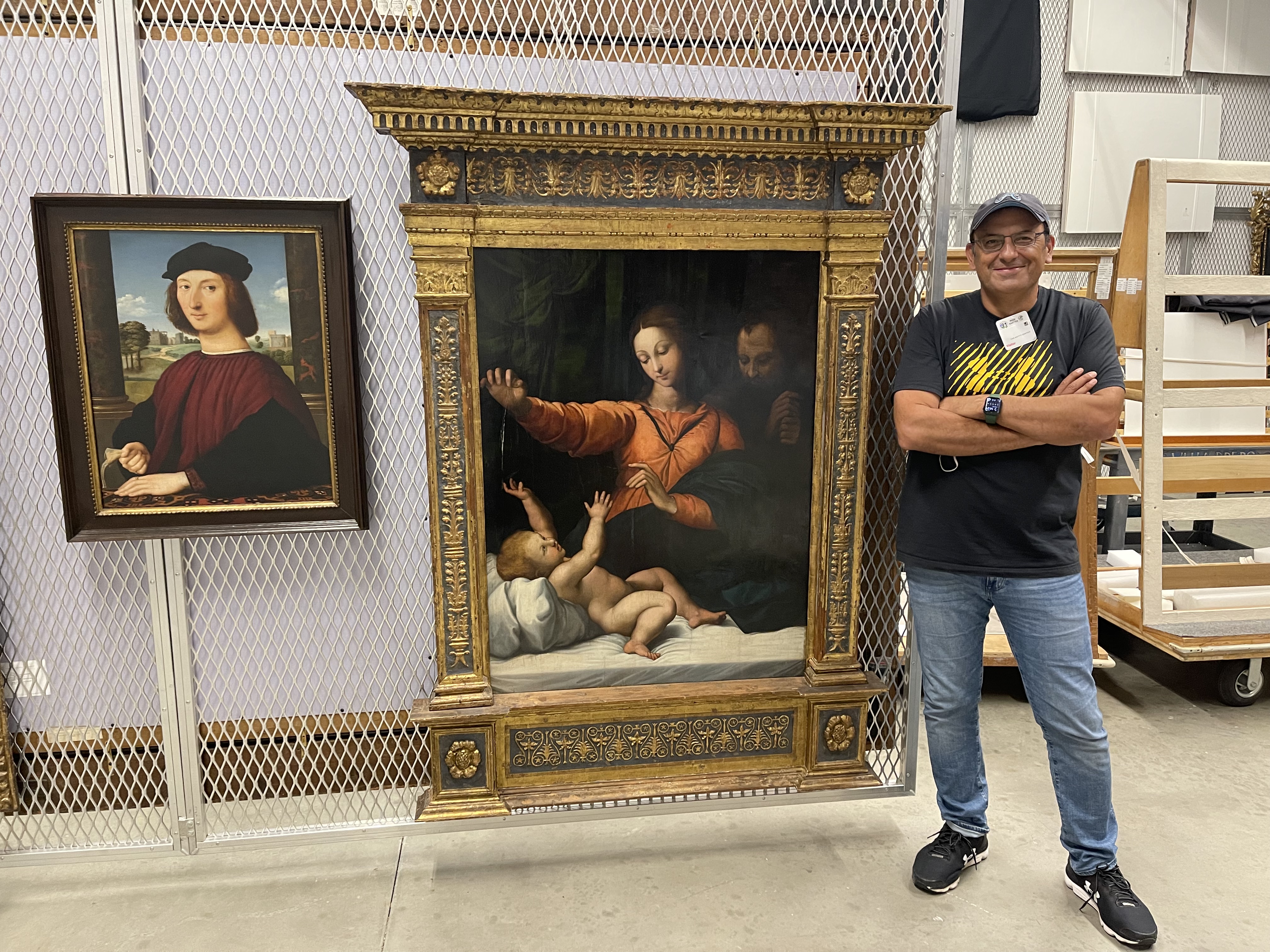
With Raphael works in museum storage — one of many visits behind the scenes.
Art history turned out to be a perfect test case. I launched a systematic research project to encounter as many works by Raphael as possible firsthand — visiting museums, drawing libraries, and storage facilities across three continents — while building the data infrastructure that would eventually become MyRaphaelQuest.
The result is an application that brings together firsthand encounter knowledge, scholarly sources, and AI generation to create a genuinely personalised museum companion — one that rewards curiosity rather than rewarding prior knowledge.
The scope of the journey
Most people encounter Raphael through reproductions. I set out to see the works themselves — in the rooms, drawing libraries, and storage facilities where they actually live. What began as personal curiosity became a systematic research effort, documented encounter by encounter, institution by institution.
That research — systematic, firsthand, and continuously documented — is the foundation that makes MyRaphaelQuest possible. A first proof of concept was developed and tested around the Met's Raphael: Sublime Poetry exhibition (March–June 2026), with design principles informed in part by conversations with a Met representative working on emerging technologies. MyRaphaelQuest remains an independent project and is not an official Met product, partnership, or endorsement.
Academic context
Art history is a knowledge-rich domain where extraordinary expertise exists — in scholars, curators, conservation records, and specialist publications — but has never been made genuinely accessible to the people standing in front of the works. MyRaphaelQuest is built on the proposition that AI, applied to properly structured firsthand knowledge, can close that gap.
The system serves three communities simultaneously: the visitor who deserves more than a wall label; the institution that holds knowledge it cannot currently scale; and the research community whose findings rarely reach beyond specialist journals. Each has an unmet need. MyRaphaelQuest addresses all three.
A knowledge base built from firsthand visits — not secondary sources — grounded in 5,000+ documented encounters across 71 institutions.
A ten-theme taxonomy — craft, provenance, patronage, iconography, and more — that lets visitors follow their own curiosity through a body of work.
Every generated text is tied to curated, verified knowledge assets. No hallucination. No generic description. Real sources, real voice.
A new channel for scholarly knowledge to reach the audiences it has never previously been able to access — in the room, at the moment of the encounter.
MyRaphaelQuest — the app
MyRaphaelQuest runs on any mobile browser — no download required. Visitors select a persona, arrive at a work, and receive a personalised hook: a piece of writing that rewards stopping, grounded in real sources, and written in the voice of someone who has genuinely stood in front of that work. From there, they can open thematic deep dives — each one generated from curated knowledge assets, each one specific to what they are looking at.
The experience is not a chatbot. It is not an audio guide. It is a companion that knows what the sources say, understands what the visitor is interested in, and delivers the right content at the right moment — in seven languages, without installation, and without requiring any prior knowledge of the artist.
Personalised hooks
Generated text that rewards stopping — grounded in real sources, never generic, never a wall label rewrite.
Thematic deep dives
Craft, provenance, patronage, connoisseurship — each card leads to a focused, evidence-backed exploration.
Encounter voice
Personal observations from standing in front of the works inform the content — visitor voice, not catalogue voice.
Seven languages
English, Italian, French, German, Spanish, Portuguese, and Dutch — on any mobile browser, switching mid-session.
Academic aspirations
MyRaphaelQuest is the empirical foundation of an ongoing academic research programme. The central question: can AI-powered personalisation genuinely improve the quality of the encounter between a visitor and a work of art — and if so, how, and under what conditions?
The project has generated a dataset of encounter records, knowledge assets, and visitor interactions that no existing academic study has been able to assemble from firsthand research. That dataset is the basis for a PhD inquiry currently in development.
Experience it yourself
MyRaphaelQuest is currently in a controlled testing phase. If you'd like to experience the app with a personal account, please fill in the form below. We'll be in touch within 48 hours.